


Try it right now
Draw a card
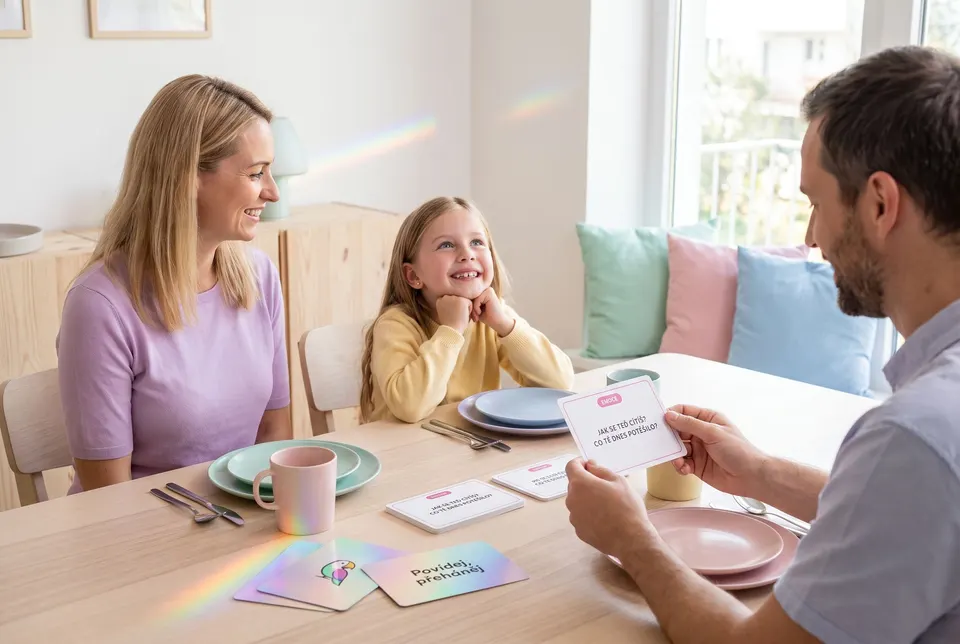
Tap the deck and answer the question — maybe right now, over dinner.
Conversation cards for kids and parents
Put the phones down and go on an adventure with your children or grandchildren. Talk, exaggerate — and above all, have fun.

Our story
In the everyday rush of nursery, school and work, we often forget the simplest yet most important thing: talking to each other. Days fly by and conversations shrink to “How was school? Fine.”
That is why we made these conversation cards. To get the conversation flowing. To get to know our children more deeply. To laugh together. To be close not only physically, but emotionally too.
Answering questions becomes a game you will look forward to every day.
— From parents, for parents
320 cards · 8 categories
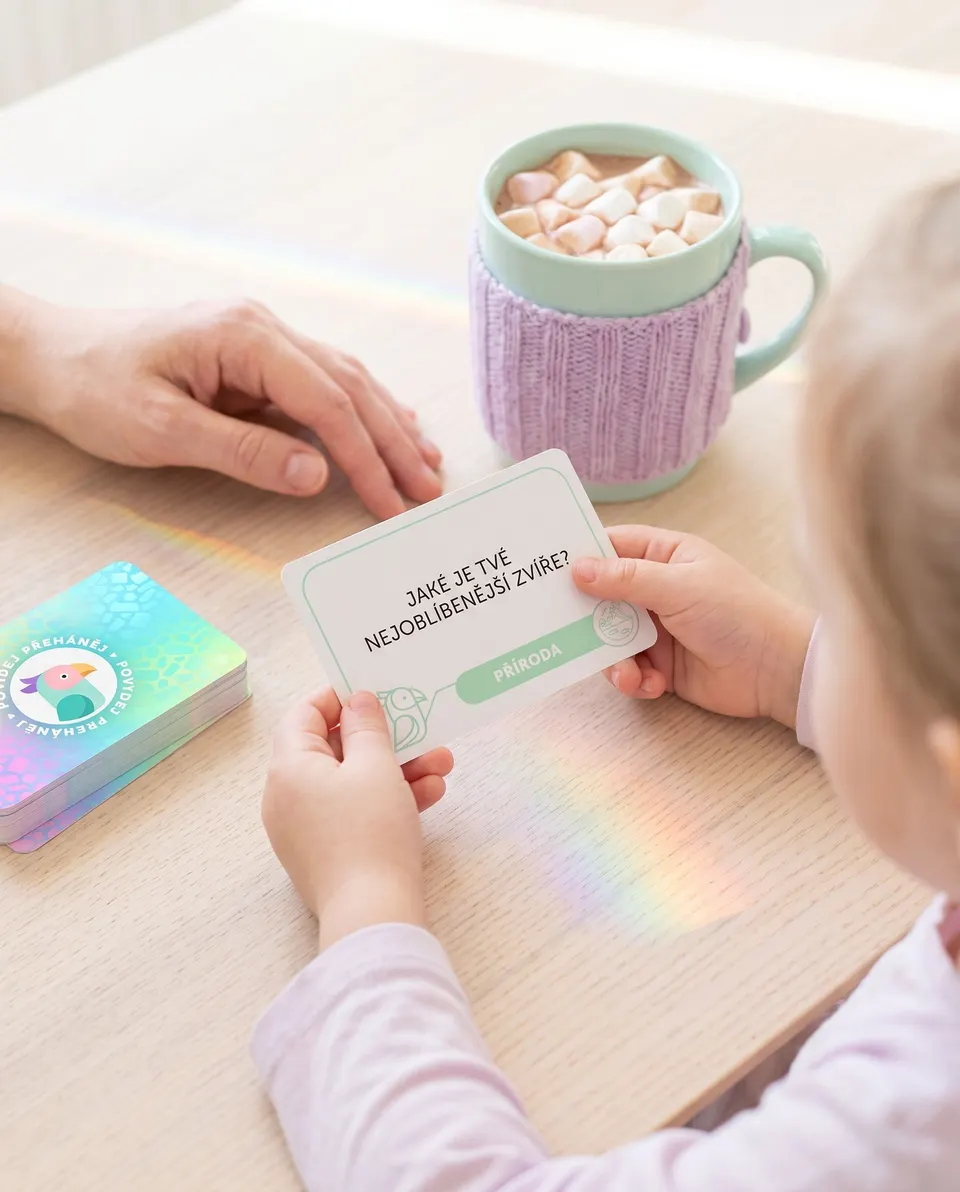
From light warm-up questions to the hidden corners of the soul. Every category has its own colour and icon, so even children who can’t read yet recognise it.
 Emotions
Simple questions to start talking about feelings, emotions and everyday joys.
40 cards
 Fantasy
Opens the door to imagination and playful ideas. Sparks creativity and the courage to dream up new worlds.
40 cards
 Relationships
About our relationships with the people around us and with ourselves — family, friendship and trust.
40 cards
 Me & my body
Questions that help children get to know their body, build a positive relationship with it and think about caring for it.
40 cards
 School of life
The experiences that shape and teach us — from nursery and school all the way to work.
40 cards
 Nature
Connecting with nature, its rhythms and calm, and thinking about how we treat the world around us.
40 cards
 What if
Hypothetical situations and alternative possibilities that look at reality from different angles.
40 cards
 Hidden corners
Room for deeper, personal and sometimes unspoken thoughts — a safe place to share secrets, worries and inner questions.
40 cards
Try it right now
Tap the deck and answer the question — maybe right now, over dinner.
How to play
One card over dinner, or a whole afternoon with grandma. There is only one basic rule:
In this game, there are no wrong answers.
Game:
Use the cards every day — as a small ritual, a game after dinner or a quiet moment before bed.
Game:
See how differently we can see the same thing.
Game:
Adds surprise and choice. Made for longer games.
Game:
One player becomes the dealer for a while.
Game:
Great for more sensitive children, introverts, or the Hidden corners category.
Why these cards
A fun card game full of questions that naturally builds vocabulary, encourages thinking and deepens the bond between parents and children.
We support independent reading — capital letters are the first ones pre-schoolers learn.
The typeface makes reading easier and suits readers with dyslexia and ADHD.
No single right yes-or-no answer — just room to think.
We created the cards together with children, educators and parents.
Sturdy card stock laminated on both sides, and a 3D-printed box that doubles as a card dispenser.
These are not just conversation cards. They are space for sharing, understanding and moments you won’t forget.
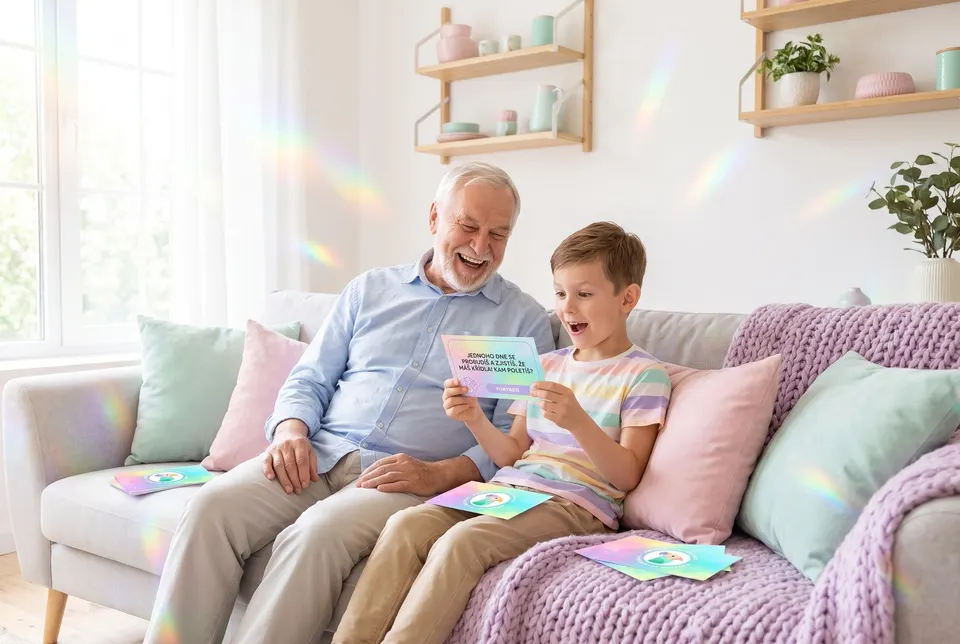



One day you wake up and find you have wings! Where will you fly?
FantasyThe Povídej, přeháněj set
Everything you need to get your family talking more.
Launching soonPrice coming soon
Let us know you’re interested — you’ll hear from us first.
FAQ
For children from 4 years old and their parents, grandparents and older siblings. An adult reads the question to younger children; school kids can read the capital letters on their own.
2 to 8 players. It works just as well with one parent and one child — over dinner or at bedtime.
As long as you like. One card a day as a little ritual is enough, or play one of the five game variants for a whole afternoon.
That’s fine — there are no wrong answers in this game. In “Swap or together” a child can swap the question or answer it together with someone they choose.
Children learn to read capital letters first, so the cards support independent reading even for pre-schoolers. The typeface is also suitable for readers with dyslexia.
No. The cards are not intended as a therapeutic tool. They are questions for the joy of talking together and getting to know each other better.
The cards are sturdy card stock laminated on both sides. The box is 3D printed, because paper boxes are the first thing to fall apart — and it doubles as a card dispenser.